What a Wedding Content Creator Actually Does

Sabina Yasirova
Content Creator & Producer
Sabina Yasirova founded Como Content Creator after several seasons filming weddings around Lake Como, and is co-founder and producer at the wedding film studio YASIROV Films. We put to her the questions couples send us most often, starting with the one that turns up in almost every first email.
Let's start with the obvious one. What does a content creator actually do at a wedding?
I follow the day with a phone, and on the Hybrid package with a VHS camera as well, filming vertically the whole time. Not set-ups, not posed portraits. The walk down to the ceremony, someone fixing a strap, the first reaction when the doors open, the two minutes on the boat when everyone finally relaxes. Part of it goes to the couple while the wedding is still running, so there is something to post that evening rather than a week later. The rest is edited and sent within 48 or 72 hours, depending on the package.
Is this a replacement for a wedding videographer?
No, and I would rather lose a booking than let someone believe it is. I co-founded a film studio, so I know exactly what goes into a wedding film: a crew planning around the light, proper sound, a structure that gets built in the edit over several weeks. That film is the version you sit down and watch on an anniversary, and for most couples it is the more important of the two.
What I make is watched on a phone for fifteen seconds and sent to your sister. Both are video. They are not the same job, they do not use the same tools, and they are not judged by the same standards. If a couple can only book one of us, I tell them to book the film.
Then why start a separate service instead of adding content to the film packages?
Because one person cannot do both properly at the same time. A filmmaker composing a shot has to hold position, wait for the light, keep the frame clean and stay invisible. I am doing close to the opposite: moving constantly, getting in among people, changing angle every few seconds, and turning material around in hours instead of weeks.
Bolt one onto the other and something gets done badly, usually the film. Keeping them separate means the videographer keeps doing what they are good at, and I keep doing what I am good at, on the same day, without either of us compromising.
What is the philosophy behind the content you shoot?
Closeness. It should look like it was filmed by a friend who happens to have a very good eye, from inside the group rather than from across the room. Slightly imperfect is fine and often better - a frame that moves because the person holding it is walking backwards up the steps with everyone else reads as real in a way a locked-off shot does not.
Vertical is not a compromise here either. It is the native format, framed for the phone from the first second rather than cropped down from something that was composed for a screen.
What do we actually receive, and when?
Reels of up to 15 seconds filmed through the day (two on the Basic package, three on Extended and Hybrid), plus one Highlight Reel of up to a minute. The Hybrid package adds a VHS Reel of up to 30 seconds and the raw material. Some of it reaches you during the wedding itself. The phone-shot packages are delivered within 48 hours. The VHS camera package takes 72, because there is considerably more footage and it needs proper grading before it goes anywhere.
Do you work alongside the photographer and videographer, or instead of them?
Both happen. Most of my weddings have a full photo and video team, and then a real part of my job is staying out of their frames. I know where a videographer needs to stand during the ceremony and the first dance, and I plan my movement around that rather than discovering it mid-shot.
Some couples book only a content creator, often for a smaller celebration or a second day. That works too. What does not work is booking me and expecting a film at the end of it.
You shoot almost entirely on Lake Como. Does the place change how you work?
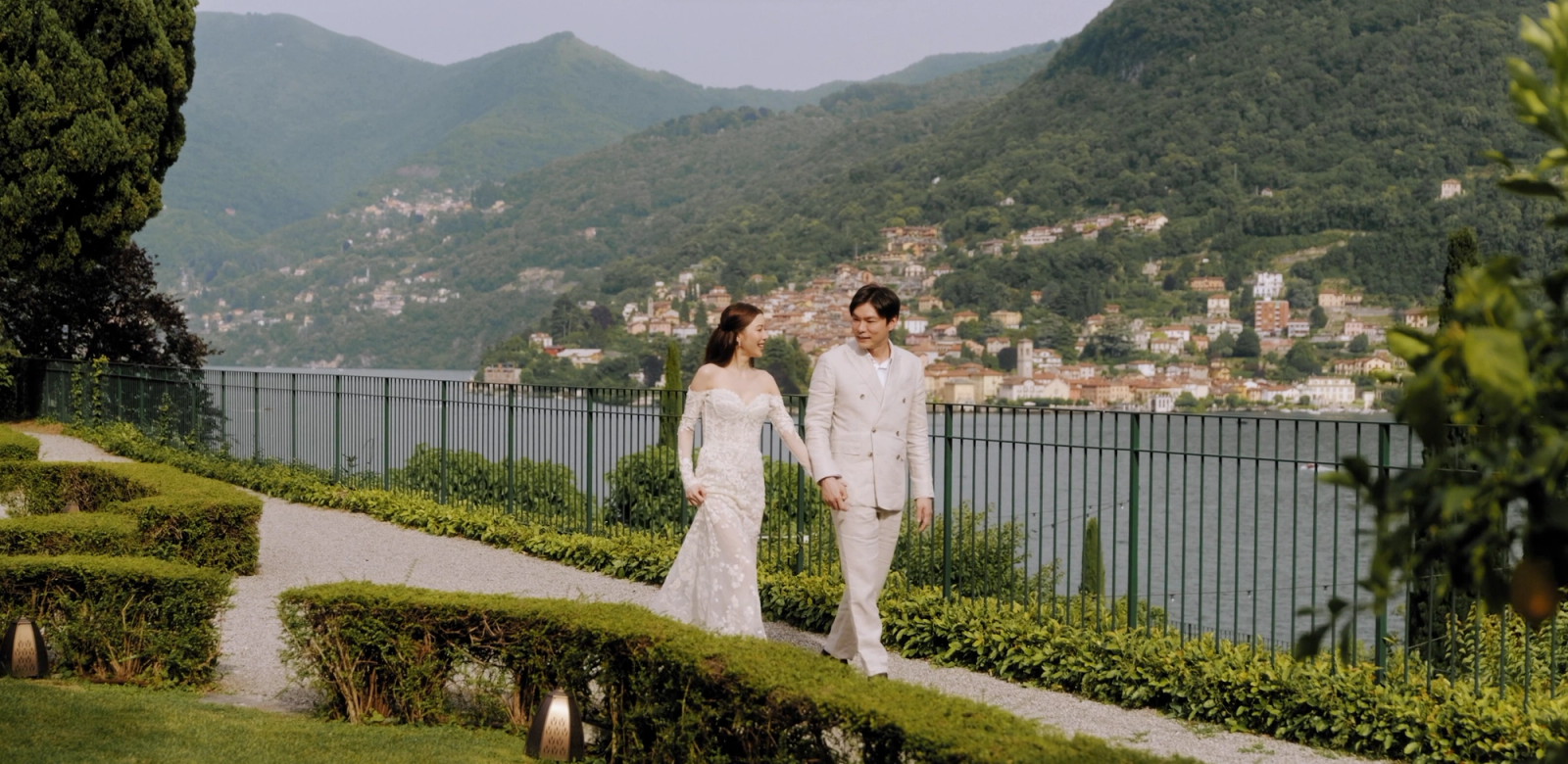
Constantly. The day moves here in a way it does not elsewhere: boats between villas, guests walking up narrow streets, ceremonies timed to light coming off the water that changes faster than anyone plans for. There is very little standing still.
That suits this kind of filming, because you are already moving with everyone, and on Como a lot of the best moments happen in transit rather than at the scheduled points of the day. It also makes logistics part of the service: travel and accommodation are included for weddings on the lake itself, so nobody is paying extra for the drive from Como to Bellagio.
How much does it cost, and how do we book?
There are three packages. Basic is €1,200 for up to 6 hours, Extended is €1,700 for up to 8 hours, and Hybrid, with the VHS camera, is €2,000 for up to 10 hours. Travel and accommodation are included for weddings on Lake Como; anywhere else is quoted separately. Once you have a date and a venue, send them through the contact form and I will confirm availability. If you are still deciding whether you need this at all, I wrote down what a season on the lake taught me.